Wednesday, November 7, 2012

Innovating? (Part 2)

XPS 12 Convertible Ultrabook
Now Windows 8 is apparently what all the manufacturer's were waiting for in order to start getting creative with their designs. Even Dell decided to join the party with their creative convertible XPS 12 Ultrabook. It features a fully rotatable screen allowing you to flip the screen so it faces the other side and turns into a tablet. The body itself offers a very premium, and durable feel. It features a machined aluminum, carbon fiber, and the glass is Corning Gorilla Glass. After years of some pretty standard or mediocre designs it's nice to see Dell branching out and trying new designs.
ATIV Smart PC


Samsung is also trying their hand at the convertible tablet/pc combo with their new ATIV Smart PC. Now it's noticeably similar to Asus' initial approach. However they have also added their own tweaks to the design, making it more streamlined, and providing it with S Pen functionality. While not as original as some of the other designs we've seen here it's still nice to see them at least try a different approach to their laptops. Although I do hope to see something more original from Samsung sometime in the future. They might just be playing it safe unsure if these new convertibles will sell well.


VAIO Duo 11
Sony, and Toshiba both decided to approach their designs in a rather similar design. They implemented a screen that slides over the keyboard, and track pad to cover it, and put the screen front and center. Sony's solution comes in the form of the VAIO Duo 11 with an 11.6" screen. Toshiba's is the Satellite U925t Ultrabook which features a 12.5" screen. However the difference comes in the fact that instead of a touch pad the VAIO has a trackball and relies more on the touch screen and included stylus. Whereas the Satellite does come with a touch pad, other than that however the two are quite similar.


Satellite U925t
Overall I'm quite excited for the new influx of creative designs, and to finally see manufacturer's branching out and experimenting with new things. I think this can only lead to new more creative and fun designs. We're finally seeing the end of the traditional simple clamshell laptop design. Microsoft has done something interesting, unique, and new with Windows 8; and as a result we're finally seeing manufacturer's follow suit and trying new things.

Google Credit Card?

So a couple of weeks ago, on Monday October 22nd to be precise Google announced that MetroPCS was now going to begin supporting Google Wallet. They also announced that if you had the Galaxy S III on Metro you could now download the app and start using it. They also decided to tease us by letting us know something new was coming to Wallet but not going into details. But after what was mostly likely an unintentional change in the Google Wallet support site, we can now speculate, and guess that a Google Wallet credit card might be on its way. Now the site lists eligible devices that can be used with the Google Wallet Card. It tells us that all Android devices using Gingerbread (2.3.3) and up can download the Google Wallet app for use with the card. However it points out that to use the tap to pay functionality, your phone needs to be NFC (near field communication) enabled.

Now while Google is being secretive about the whole thing the good folks over at Androidpolice managed to get their hands on some nice leaked information. Now what does this information tell us you ask? It seems to show us that the Wallet card will function like any normal credit card allowing it to be used anywhere you'd use a credit card. It would automatically use whichever card is your default mobile payment method in the app, and also allows you to still make purchases if your phone happened to die while you're out. One less thing to worry about.

Now this news is likely to excite some, and have no effect on others; and while it remains to be seen if this will increase overall adoption of the Google Wallet service in general or if it will only attract the same few it currently does. Now while I'm skeptical to think offering a physical card will suddenly make people start using their phone to pay for everything, I do think it's likely to attract new customer's. Especially seeing how the number one complain I've heard from people who say they don't want to use Google Wallet is the fact that they feel NFC is insecure. This may do enough to put their minds at ease and allow them to give the service as a whole a chance. That may be Google's plan to begin with, if so I think it's a solid plan. For their sake I hope this increases the amount of people using Google Wallet, seeing as so far adoption has been less than stellar.

Tuesday, November 6, 2012

Innovating?

Editor's Note: Because of an issue I had with the site, the original article was lost before I could back it up, as such I have had to rewrite it and have broken it up into two parts.

Transformer Pad Infinity
Competition is a good thing, particularly when it drives innovation. When the first Android tablets running 3.0 Honeycomb (the tablet optimized OS for Android), released they were all a similar design. All for one that is, Asus was the first to experiment with a new design for their tablets with their Transformer Pad tablet series. The tablet itself was pretty standard design with a nice 10.1" display, but what distinguished it was the optional dock accessory it had which transformed it into a notebook. It also adds USB ports has a full keyboard, and multi-touch track pad, and adds battery life to the tablet when connected. It was received quite well, and Asus was praised for experimenting with a new design.

VivoTab RT
Asus decided to also bring the design over to their new Windows RT tablets in the form of their VivoTab RT. They will also be launching the VivoTab featuring the full version of Windows 8. I expect these to be met with even more success than their Android counterparts given the fact that Windows 8 is designed to work both as a notebook and standalone tablet. An advantage Android didn't have. I'm glad to see Asus still unafraid to experiment with their designs.


Taichi 21 Series
However not ones to stay content recycling their old designs they took their innovation to a brand new level in the form of the Taichi 21 Series. Now out of all the new Intel inspired Ultrabook convertible designs I've seen recently this has to be the one that most got me excited. The back casing features a full touch screen allowing it to function as a tablet when you close it. When it's open it features a full keyboard and touch pad. To better things Asus also optimized their software allowing you to do some cool stuff with the two screens. Video showing how it works here. This is definitely one of the most original implementations I've seen from any manufacturer; and I think it will appeal to a wide audience.


IdeaPad Yoga 13
This time around the manufacturer's decided they aren't going to just sit around and let Asus take all the innovative ideas. So in comes Lenovo with their new IdeaPad Yoga 13, which features a flexible display; which allows it to be used in different modes. It can open into a normal laptop mode, or fold back to be used as a tablet, and it can even be folded to use the keyboard as a stand. Better than writing is showing so video here

Monday, November 5, 2012

October Recap

Nexus 7
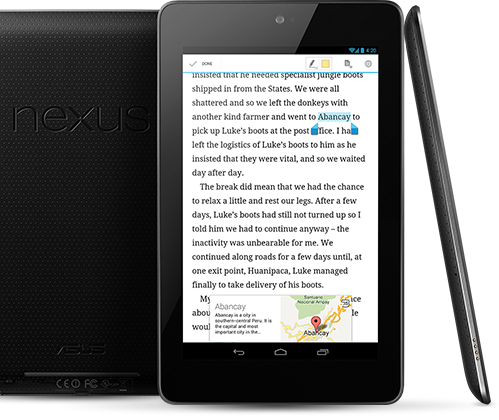
The month of October was pretty interesting for the mobile world. A lot of things were announced, and launched. Google announced their new updates to the Nexus line which included an updated Nexus 7 with more storage, and brand new Nexus 4, and Nexus 10. The Nexus 7 will now come in 16 GB for $199 and 32 GB for $249. The new 16 gig version will be replacing the old 8 gb one. They also gave it HSPA+ functionality on T-Mobile. It will retain the same quad-core Tegra 3 processor, and 1280 x 800 7 inch display. 


Nexus 4
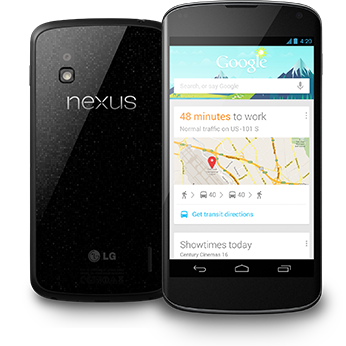
The new Nexus 4 was announced and will be launching November 13th. It is going to be a real powerhouse coming with a 4.7 inch 1280 x 768 IPS HD display. It will be powered by a Qualcomm quad-core Snapdragon S4 Pro processor, and 2GB of RAM to ensure it runs buttery smooth.. And as with any nexus device it will launch with Android 4.2. Now if you think all this will break the bank, here is where it gets really good. The 8GB version will start at $299 unlocked contract free with the 16GB flavor coming in at $349.


Nexus 10
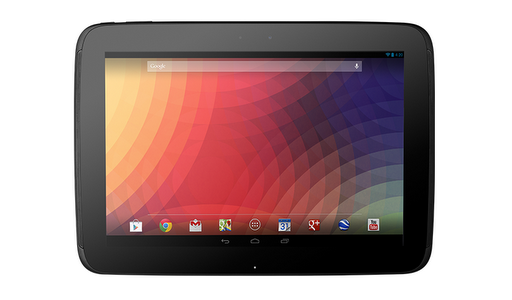
Let us not forget about the brand new Samsung made Nexus 10. It will start at $399 for the 16 GB version. Front and center you notice the large 10 inch screen with an amazing 2500 x 1600 resolution. Making it the highest resolution tablet on the market right now. Throw in a dual-core A15 processor with 2GB of RAM, and Android 4.2, and you've got another impressive Nexus device.


Galaxy Note 2
Samsung also released their long awaited Galaxy Note 2 on T-Mobile, Sprint, and US Cellular, and announced it will be releasing on Verizon, and AT&T sometime in November. While it was a bit disappointing to see a scattered release, for many the phone is more than worth it. Featuring a 5.5 inch Super Amoled 720p display, it is great for content consuming, and creation with improved functionality of the S pen. Powering it is a quad-core Exynos processor and 2 GB of RAM. They also upped the battery size to 3,100 mah allowing for you to use LTE without worry of the phone dying too quickly. With improved S pen functionality 16GB of internal storage plus a micro SD card this device is coming with a premium price. Across all the carriers this is going to be a $300+ phone with a 2 year contract extension.


Surface tablet
On non Android related news Windows 8 released this month along with Microsoft's new Surface tablet featuring Windows 8 RT. The first ever Microsoft made tablet is a daring endeavor, but they have certainly put their all into it. You quickly notice the premium design and materials used in making the device. It's impressive and demands your attention with a built in kickstand and the new Vapor MG casing. Under the hood its running the new Windows RT OS which is limited to only using the new apps from Windows store and is unable to run legacy programs. It will be running a quad-core Tegra 3 processor and 2GB of RAM. It starts at $499 for the 32GB version. However what really makes it special is it's new touch type cover which functions as a touch keyboard and track pad when open. But this amazing new accessory will run you an additional $129 if purchased separately. The Surface Pro will be coming with a few months running Windows 8 Pro, and using an intel processor. However details are still a bit scarce on this one.


iPad with Retina Display
Apple wasn't about to let Google and Microsoft steal all the thunder and announced the fourth generation iPad with retina display which will be replacing the new iPad (third gen). The fourth iPad will be available in both wifi only and LTE versions on Spint, AT&T, and Verizon. Apple will stick with the same pricing plan they've used on previous models with the 16GB Wi-Fi only version starting at $499, and $629 for LTE. It will feature a dual-core A6X custom processor with quad-core graphics chip. It will launch with iOS 6, a front facing 1.2 MP facetime HD camera, and iSight 5MP camera on the back. Both are capable of HD video with the facetime camera capable of 720p and the iSight camera doing full 1080p. Like the new iPhone 5 will also come with a lightning connector. However, not everyone was happy to hear this unusual announcement from Apple phasing out their new iPad a little over six months after releasing it. Many people felt they were getting a raw deal from Apple which normally only releases one update to their product lines every year.
iPad Mini


Rounding out important Apple news, the long rumored, almost mythical iPad Mini was finally made a reality alongside the new iPad. Featuring a 7.9 inch 1024 x 768 display and dual-core A5 processor. It will also come with LTE connectivity on the same three carriers as the other iPad. It will have the new lightning port and start at $329 for the 16GB Wi-Fi only version. However, at that price point I'm not sure why anyone would buy it over the Nexus 7 which is $130 cheaper and offers better specs on almost all fronts.


This just about sums up all the important announces and releases that happened throughout the month of October. There's definitely a lot to be excited for, and this will be a very choice filled holiday shopping season. Choice is always good for the consumer, even if it makes deciding that much harder.

Welcome!

Welcome to the Cell Junkie blog. Here I will be discussing all walks of the mobile world, with a special interest in smart phones and tablets. I will try to provide unbiased views and opinions on as much as I can. I will also review as many different devices and OS updates as I can, and share general news relating to the mobile industry. Hope you enjoy the ride as I embark on this adventure. Most of all though I hope you walk away a more informed consumer every time. Ultimately that's what I'm here for to help you make an informed smart decision and weigh all the options.